
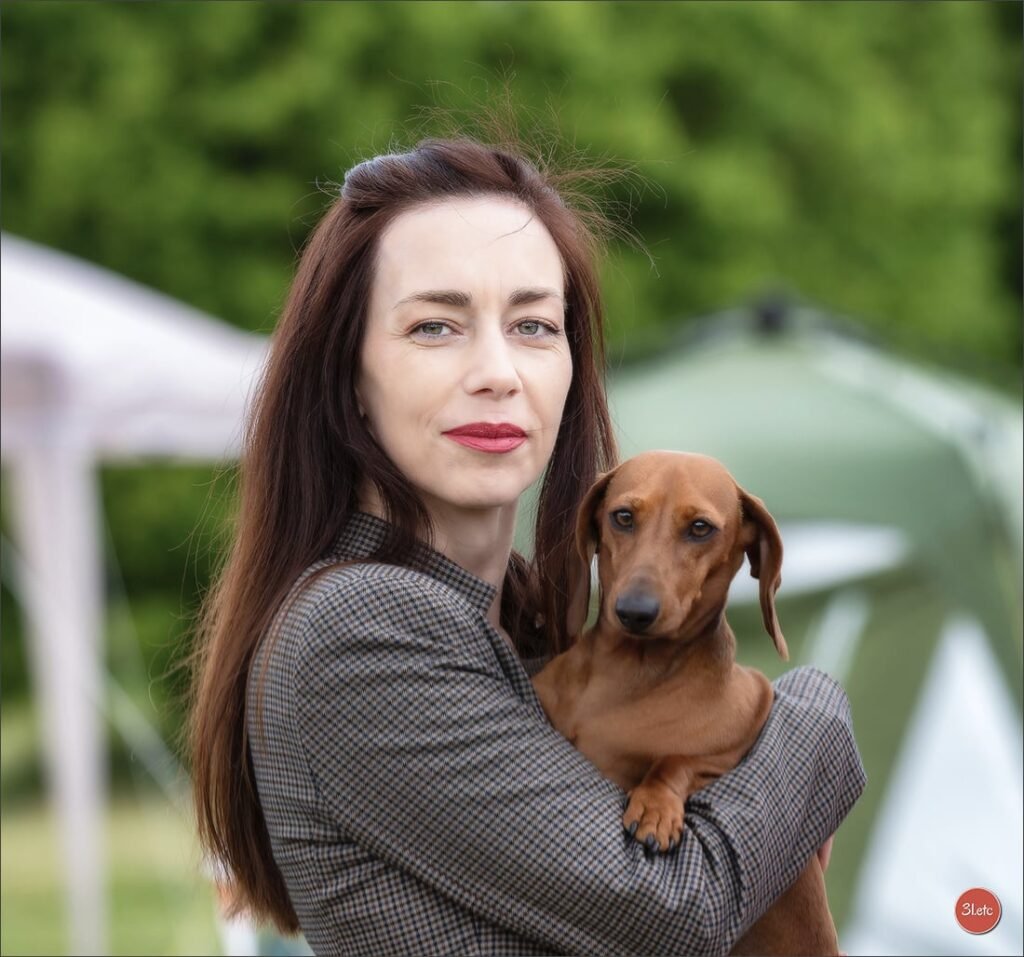
Some people grow up with dogs. I grew up learning from them.
My grandfather bred Istrian Hounds in Montenegro. Before I could read, I was watching him move quietly around his dogs – observing, assessing, never rushing. He never explained what he was doing. He didn’t need to. Something about that quiet, unhurried attention stayed with me. I’ve never lost it.
But my first dog – truly my own – was an Irish Setter. If you know the breed, you’re already smiling. Magnificent, ridiculous, full of fire and joy and absolutely no interest in doing what you ask. I loved him completely. And he taught me something that years of showing and judging later only confirmed: dogs don’t misbehave. They communicate. The question is whether we’re paying attention.
I’m Jelena Musikic. I’ve spent the better part of three decades living and breathing the world of dogs – as a breeder, as an FCI judge, and as someone who simply cannot imagine life any other way.
My breeding journey began in 1998 with German Hunting Terriers – a breed that is small in size and enormous in character, demanding real understanding from anyone who lives with them. Later came the Montenegrin Mountain Hound, the national breed of my homeland, a dog shaped by centuries of working alongside hunters in some of Europe’s toughest terrain. Between 2018 and 2024 I co-bred Lagotto Romagnolo under the kennel name Arizona Line Lagotto – a breed that stole my heart so completely that one now lives with me here in Munich.
My Lagotto is the dog I come home to every day. Smart, sensitive, stubborn in the most endearing way, and absolutely thriving in city life – mostly. Watching him navigate Munich, with its traffic and strangers and endless novel smells, has given me a perspective on urban dog behavior that no show ring ever could. He reminds me daily that the gap between what we expect of our dogs and what we actually prepare them for is where most of the problems begin.
In 2011 I earned my judging license through the Fédération Cynologique Internationale – the world’s largest cynological organization – and have since judged at international and specialty shows across Europe, across eight FCI groups. Standing ringside and assessing hundreds of dogs across breeds and temperaments teaches you to read a dog in seconds. Not just structure and movement, but temperament. Tension. Confidence. Fear dressed up as aggression. Curiosity mistaken for dominance. These distinctions matter enormously – in the ring, and even more so in everyday life.
I also hold a Master’s degree in Information Systems, which perhaps explains why the science of dog behavior has always fascinated me alongside the practice of it. Stanley Coren’s research on canine intelligence, Alexandra Horowitz’s work on dog perception, the growing body of ethological science – these gave language and evidence to things I had observed for years but couldn’t always articulate. Real Dog Science grew out of that combination: decades of hands-on experience, grounded in what the research actually says.
I live in Munich now, a city I love and a city that presents dogs – and their owners – with a particular set of challenges. The density, the noise, the overstimulation, the well-meaning strangers who reach for your reactive dog on the pavement. Urban life is genuinely demanding for many dogs, and the advice most people find online was not written with city dogs in mind.
That’s why I started writing.
Real Dog Science is for the dog owner who wants more than tips. Who wants to understand why their dog does what it does. Who suspects there’s a better way – and is willing to look at the science, the behavior and the individual animal in front of them to find it.
Your dog is trying to tell you something. This is where we learn to listen.
– Jelena