
Why does my dog follow me everywhere? Attachment vs. anxiety
Sooner or later, almost every dog owner notices that they have acquired a small, furry shadow, a dog who gets up from the sofa when you go to the kitchen, waits outside the bathroom door, and lies down on your feet the moment you sit at your desk, and the question that follows is nearly always the same: is this sweet, is this normal, or is this a problem I should be worried about? The honest answer is that it can be any of the three, and what separates them is not how closely the dog follows you but what happens inside the dog when you stop being reachable.
Why dogs follow their people in the first place
Dogs are one of the few species that have been shaped, over many thousands of years, to pay attention to humans, and that history is the simplest explanation for most of the following. A dog who stays near you is a dog doing what dogs were selected to do, which is to keep track of the person who feeds him, protects him and, in the case of working breeds, tells him what the day’s job is going to be.
The researchers József Topál and Ádám Miklósi, who adapted the attachment tests used on human infants so that they could be run with dogs and their owners, found that dogs treat their person as something like a secure base: they explore more confidently when you are present, they check in with you when something unfamiliar happens, and they show clear signs of relief when you return. That pattern is a healthy sign, and it is not a flaw in the training. Add to this the finding by Miho Nagasawa and her colleagues in 2015 that mutual gazing between dogs and their owners raises oxytocin in both, the same hormone involved in bonding between parents and infants, and it becomes clear that a dog who watches you from across the room is, in a quite literal sense, building and keeping the relationship.
There are also much plainer reasons. You are interesting, because you are the source of food, walks, games and anything else that happens, and a dog who has learned that something good tends to follow you around the flat is making a sensible bet. Dogs also love routine, so if the bathroom door has always been followed by you coming out and giving him a bit of attention, he will wait for it.
Why working breeds do it more
Some breeds do this far more than others, and anyone who has lived with a Doberman, a Weimaraner, a German Shepherd or a Border Collie will tell you it is not an accident. These breeds were developed to work in close partnership with a person, reading small signals, staying within reach, and responding quickly, and a dog selected over many generations for exactly that closeness will keep doing it in a flat, where the job has gone but the instinct has not. Stanley Coren’s work on breed differences makes the point that working and herding breeds are generally among the most attentive to their handlers, and in a small apartment that attentiveness has nowhere else to go, so it all lands on you.
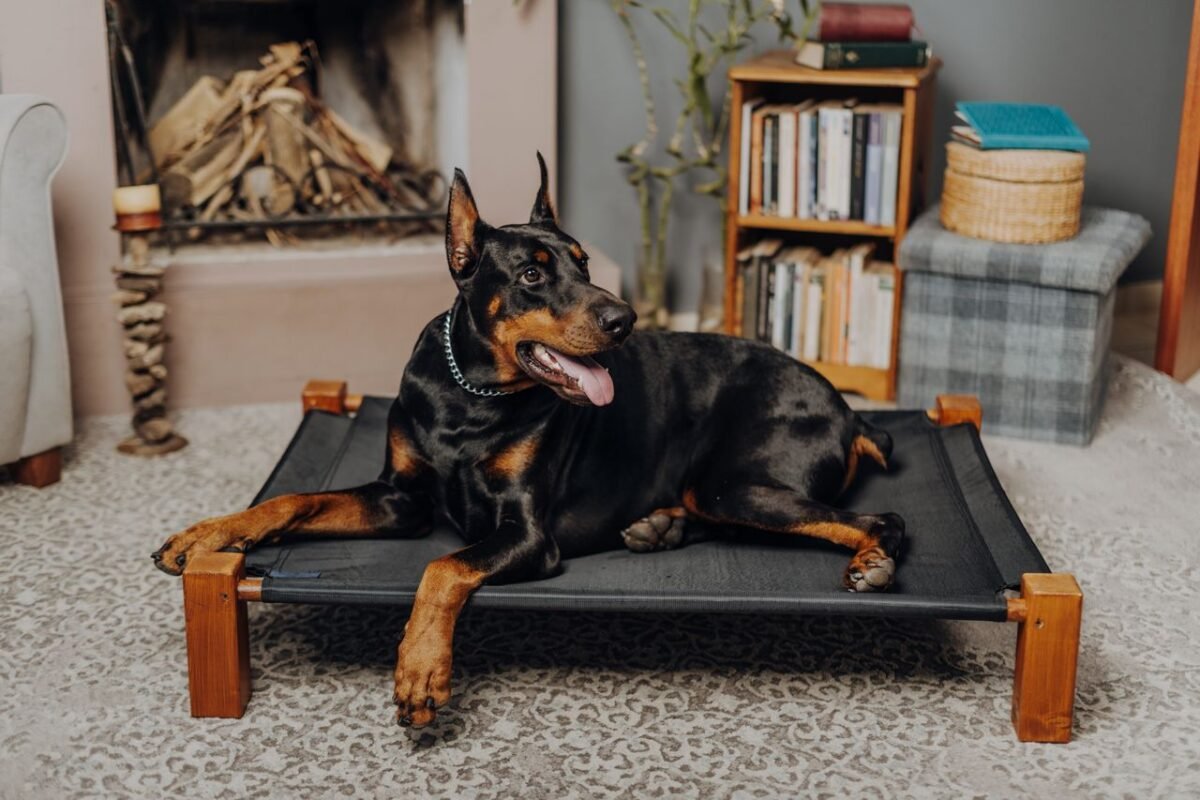
The Doberman is a good example, and it is often called a Velcro dog for a reason that is built into its history: the breed was developed in Germany in the late nineteenth century by Louis Dobermann, a tax collector who wanted a loyal, alert dog to stay close to him on his rounds. A dog selected for generations to be the constant companion and protector of one person does not become independent because that person now lives on the third floor, and the label is a compliment to the breed’s purpose rather than a diagnosis.
The question that actually matters: What happens when you leave?
Here is the distinction I would encourage every owner to make. A dog who follows you closely but is relaxed is showing attachment. A dog who follows you closely because he is anxious about being alone is showing something else, and the difference is easiest to see in the moments around separation.
A securely attached dog tends to:
- settle quickly when you sit down or go to another room, rather than hovering,
- take a chew or a treat when you leave, and relax within a few minutes,
- greet you calmly when you come back, even if he is happy,
- cope with a closed door between you for a short time.
A dog who is struggling with being alone tends to show signs like these:
- pacing, panting or trembling as you get ready to leave,
- refusing food when you are out of sight,
- barking, howling or whining shortly after you go,
- destroying things near the door or window, or toileting indoors despite being house-trained,
- extreme, frantic greetings that take a long time to settle.
Research by Flannigan and Dodman, looking at risk factors for separation anxiety in dogs, suggested that the condition is more complicated than simple over-attachment, and that it does not always correlate with how much a dog follows his owner at home. In plain words, a clingy dog is not automatically an anxious dog, and an apparently independent dog is not automatically a calm one. What counts is how the dog copes when you are actually gone, which is why a short test is more useful than a guess.
A simple test you can do this week
Put a camera or phone on record in the room where your dog usually stays, leave for ten or fifteen minutes with a chew toy or a stuffed food toy, and watch the footage afterwards. If he settles within a few minutes, eats the treat and eventually lies down, you are almost certainly looking at a dog who is strongly attached and perfectly healthy. If he paces, vocalizes continuously, ignores food and does not settle at all, that is a different conversation, and one worth having with a qualified behaviorist or your vet rather than trying to solve with advice from the internet.
What helps a Velcro dog feel more secure
If your dog is attached rather than distressed, a few small changes can make life easier for both of you.
Teach him that being apart is boring and safe. Practice short periods where you are in another room with a door or baby gate between you, and return before he gets worried. The goal is not to push him, but to make separation so ordinary that it stops being an event.
Stop making arrivals and departures dramatic. A big emotional goodbye or a theatrical welcome teaches the dog that those moments are important and a little stressful. A calm word, a pat and an ordinary tone are much better for a dog who finds it hard to be on his own.
Give him a place that is his. A bed or a crate, introduced slowly and kindly, with something good to chew, gives him somewhere to go that is not wherever you happen to be. Many dogs relax noticeably once they have a spot they associate with calm.
Give him a job. For a working breed especially, a daily scent game, a short training session or a puzzle feeder meets the part of him that wants to be useful, and a dog who has done real work tends to follow you around less, because he is not looking for something to do.
Do not accidentally reward the shadowing. If every time he follows you he gets attention, he will do it more. Reward the moments when he chooses to lie down on his own, even briefly, by calmly tossing him a treat or saying something quiet and kind.
When to ask for help
If your dog shows real distress when alone, hurts himself trying to escape, or cannot settle even when you are at home, it is time to speak to a professional, ideally a veterinary behaviorist or a certified trainer who works with separation problems. Early help makes a large difference, and nobody should feel they have failed their dog by asking for it.
If you want to understand the signals your dog gives when city life is too much, I put together a free guide, “5 Signs Your City Dog Is Overwhelmed,” which also covers the quieter stress signals that are easy to miss. You can grab it right away.
Frequently Asked Questions
Why does my dog follow me to the bathroom?
Most often it is a mix of attachment and habit. You are leaving his sight, he has learned you come back, and he would rather wait nearby than wonder. It is usually harmless, and it becomes a concern only if he is visibly distressed when the door closes.
Is a dog who follows me everywhere anxious?
Not necessarily. Following is common in securely attached dogs, particularly in working and hunting breeds. The real signal is how he behaves when you are out of sight for a while, not how close he stays when you are at home.
Can I stop my dog from following me?
You can teach him to settle in one place while you move around, using a bed, a mat or a chew, and rewarding him for staying put. The aim is to give him a choice, rather than to make him anxious about being near you.
Is it bad to let my dog sleep in my bedroom?
No. For most dogs it is comforting and perfectly healthy. It becomes worth looking at only if the dog cannot settle anywhere else, even for short periods.
Sources & further reading: canine attachment and the secure base effect, József Topál and Ádám Miklósi; oxytocin and mutual gaze in dogs and owners, Miho Nagasawa et al., Science, 2015; breed differences in attentiveness to handlers, Stanley Coren; risk factors for separation anxiety, Flannigan and Dodman, Journal of the American Veterinary Medical Association, 2001.