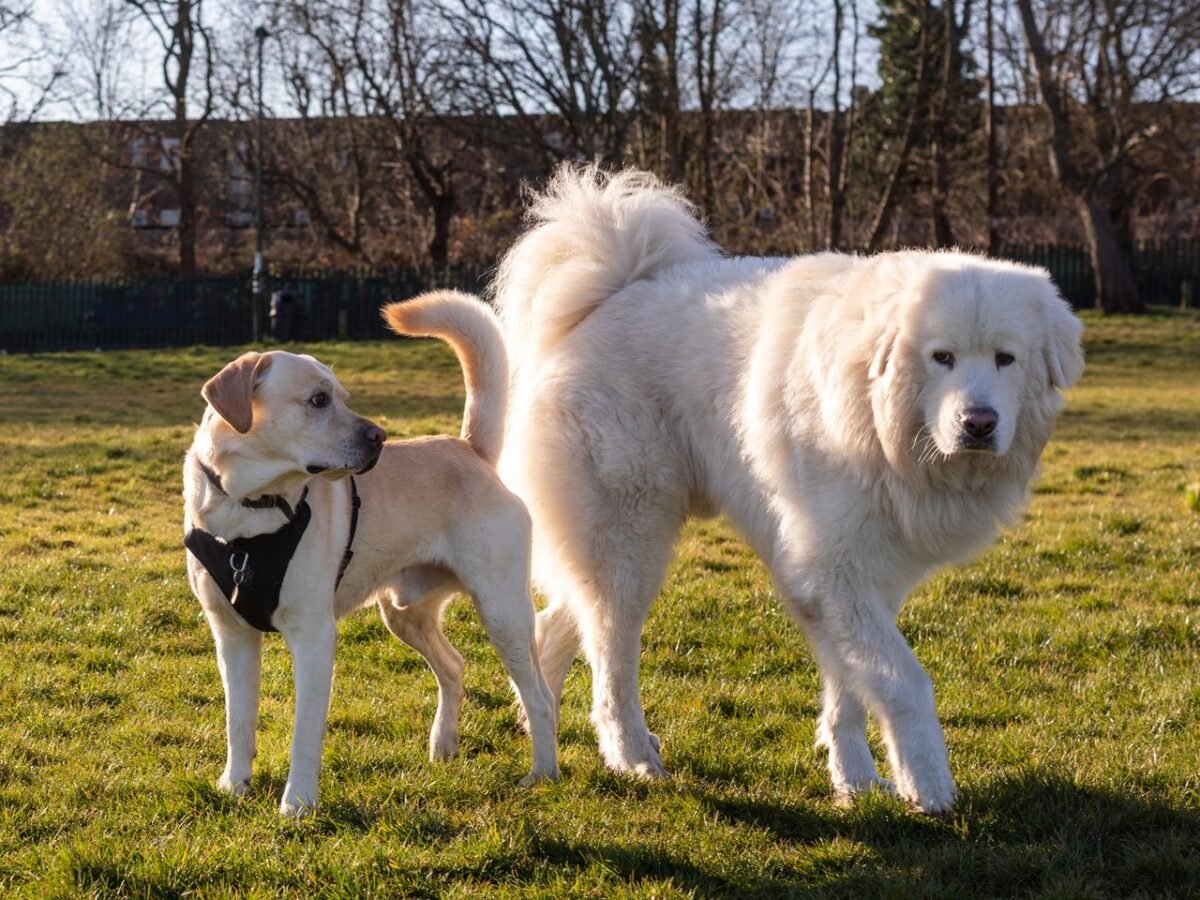
Guardian breeds and city life: Why protective instincts clash with apartment living
There is a particular kind of dog that people fall in love with at a show or in a photograph, a large, calm, watchful animal with a serious face and a reputation for loyalty, and a surprising number of them are then taken home to a third-floor flat in a busy city, where the dog’s best qualities start to look like problems. The Pyrenean Mountain Dog, the Kangal, the Caucasian Shepherd, the Anatolian, the Maremma and their relatives were not developed to be companions in the modern sense. They were developed to live alongside a flock, to stay awake at night, to notice anything unfamiliar at a great distance, and to deal with it without waiting to be told, and that is a very different job description from the one a city dog is handed.
What a guardian breed was actually built for
It helps to separate two groups that often get lumped together. Livestock guardian breeds, which in the FCI system sit mostly among the Pinscher, Schnauzer, Molosser and Swiss Mountain Dogs and the Sheepdogs and Cattle Dogs, were bred to protect animals from predators, usually with a fair amount of independence and very little need for human instruction. Personal protection and watch breeds, such as the Giant Schnauzer, the Rottweiler or the Doberman, were bred to stay close to people and guard them and their property. Both groups are protective, but they are protective in different ways, and the difference matters when you are trying to fit one into a flat.
Raymond and Lorna Coppinger, who spent decades studying livestock guardian dogs, argued in Dogs: A New Understanding of Canine Origin, Behavior and Evolution that these dogs are not “trained” to guard in the way many people imagine. Rather, they are raised with the flock so that the animals become their social group, and the guarding behavior, patrolling, barking at intruders and putting themselves between a threat and the flock, emerges from a selected temperament rather than from instruction. That is exactly why these dogs tend to be more independent than a herding dog, less eager to take direction, and far less likely to see “because I told you so” as a convincing argument.
Where the clash happens in a city flat
Now think about what an apartment building offers a dog whose entire personality is organized around watching a territory. There are footsteps in the stairwell, a lift that opens and closes at all hours, a doorbell that rings several times a day, neighbors who appear and vanish, parcels that are delivered and removed, and windows that look out onto a street full of passers-by, cyclists, other dogs and delivery vans. For a dog with a strong territorial instinct, every one of these is a patrol event, and the dog cannot make it stop, because nothing he does ever makes the “intruder” leave for good; they simply walk away, and then come back tomorrow.
The result, in my experience of watching many owners struggle with exactly this, is a dog who is on duty all day and half the night. He barks at the door, stands at the window, shadows visitors, and in the worst cases becomes wary of the lift, the corridor or the neighbors, not because he is badly behaved but because he is doing, with great seriousness, the job he was bred for, and in a city that job never ends.
Many livestock guardian breeds are also naturally more active at night, because that is when predators approach, so a dog who patrols and barks between midnight and dawn is not malfunctioning, he is working. In a building with thin walls this is the single most common reason these dogs end up in rescue or in trouble with their neighbors.
The part people underestimate: Size, strength and independence
None of this would matter so much if the dogs were small. But a Pyrenean Mountain Dog, a Kangal or a Caucasian Shepherd is a powerful animal, often over fifty or sixty kilos, with a build and a confidence that make it very difficult to manage physically if something startles him on a pavement. A reactive Chihuahua is an irritation, and a reactive large guardian dog can be a genuine safety problem, which is why early, careful socialization and a calm, consistent owner are not optional extras with these breeds. They also tend to mature slowly, often to three years, and to become more serious and more protective as they do, so the sweet, sleepy puppy you bring home at ten weeks may be a very different dog at two.
It is also worth noting how these breeds respond to training, because it affects what you can realistically expect. Stanley Coren’s rankings of working and obedience intelligence place many guardian breeds low on the list for rapid obedience, which is a measure of how quickly dogs respond to commands, and not of how clever they are. A guardian dog is making his own decisions, and the owner who wants a dog that works to instructions all day will find himself in a long negotiation.
Can it work at all?
Honestly, for most people living in a city flat, a livestock guardian breed is a poor match, and I would rather say so plainly than let someone take home a dog that will be unhappy. But there are people who do manage it, and when they do, they tend to share a few habits.
They manage what the dog can see. Frosted window film, a blocked lower window or a shifted sofa that stops the dog from standing guard at the street can make a surprising difference to a dog’s daily stress, because he is no longer being offered an endless parade of things to watch.
They teach a doorbell and visitor routine from day one. A mat or bed away from the door, a reward for going there when the bell rings, and a calm, repeated sequence for guests mean the dog has a job that is not “defend the entrance.”
They give long, calm, structured walks, not busy ones. These dogs do better with space, quiet routes and early mornings or evenings than with crowded sidewalks and dog parks, and they are often better walked on a longer line in a quiet green area than in a high-traffic street.
They protect the dog’s sleep. A dog who cannot rest cannot cope, so a quiet, dim place to retreat, ideally away from the front door, is essential, and so is a household that does not reward alert behavior at every small noise.
They accept that the dog is not a fit for every situation. Hotels, busy cafes, crowded events and visitors who want to cuddle him are not part of this dog’s life, and the best owners say no to them without guilt.
What I would recommend instead
If you love the look and the dignity of a guardian breed but live in a small city flat, there are working breeds with a protective streak that cope with urban life considerably better, such as the Giant Schnauzer in the right hands, or the smaller, more people-oriented breeds that were bred as companions with an alert, watchful side. If you already have a guardian breed, the good news is that most of the problems described above are manageable with structure, and that the dog you have is rarely “too much” so much as “under-employed and over-informed” about everything going on outside the door.
If you want to understand how a dog tells you he has had too much stimulation, including the quiet signs most owners miss, I put together a free guide, “5 Signs Your City Dog Is Overwhelmed,” which you can grab here.
Frequently Asked Questions
Can a livestock guardian dog live in an apartment?
It is possible, but it is demanding. These breeds are bred to patrol and to bark at night, so in a building they tend to find too much to guard, and their size and independence make training harder than with most companion dogs.
Why does my guardian breed bark so much at night?
Because that is when predators traditionally approached the flock, and the breed has been selected to be most alert in the dark. Reducing what the dog can see and hear, and giving him a calm sleeping area, can help.
Are guardian breeds aggressive?
Not by nature, but they are protective and wary of strangers, which can look like aggression if the dog is not socialized carefully and consistently. Good early socialization and clear management are essential.
What is the best breed for a protective but city-friendly dog?
It depends on the household, but breeds that were developed as personal companions with a watchful side generally cope better than those developed to guard a territory without human supervision. A conversation with an experienced breeder is worth far more than a list.
Sources & further reading: livestock guardian dog behavior, Raymond and Lorna Coppinger, Dogs: A New Understanding of Canine Origin, Behavior and Evolution; breed differences in working and obedience intelligence, Stanley Coren, The Intelligence of Dogs.