How much exercise does a working breed actually need in an apartment?
Almost everyone who brings a working breed home to a city flat eventually asks the same question, usually a little guiltily, usually after a long day: is the walk I just gave him actually enough? The honest answer is that it depends far less on minutes and kilometers than the internet would have you believe, and far more on what the dog was originally built to do all day, and whether any part of that job is still getting done.
Why “thirty minutes a day” as almost useless advice
You will find the number everywhere, thirty minutes for small dogs, an hour for big ones, two hours for the energetic types, and it sounds reassuringly precise. The trouble is that it treats exercise as one single thing, a sort of fuel you pour into the dog until the tank is empty, when a working dog’s needs are really made of at least three different things that do not substitute for each other very well: physical movement, mental work, and the kind of calm, unhurried time that lets the nervous system come back down afterwards.
A herding or hunting dog can trot beside a bicycle for an hour and come home still wound up, because the part of him that was bred to search, to assess, to make decisions, to work out where the sheep or the bird or the scent line went, has not been touched at all. And the reverse is also true: a dog who has spent fifteen minutes solving a proper scent puzzle will often settle more deeply than one who has just been dragged around the block twice at speed. Stanley Coren, in his long-running work on breed differences, makes the point that dogs were selected for particular jobs rather than for general athleticism, and that is why two dogs of similar size and energy can need completely different things from the same evening.
What science says about the nose
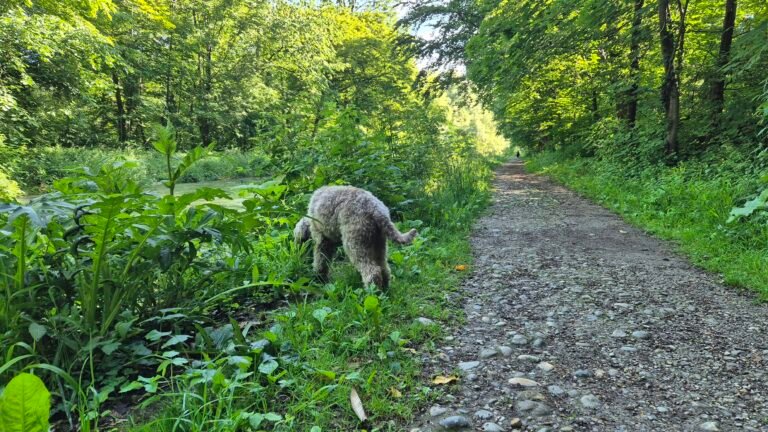
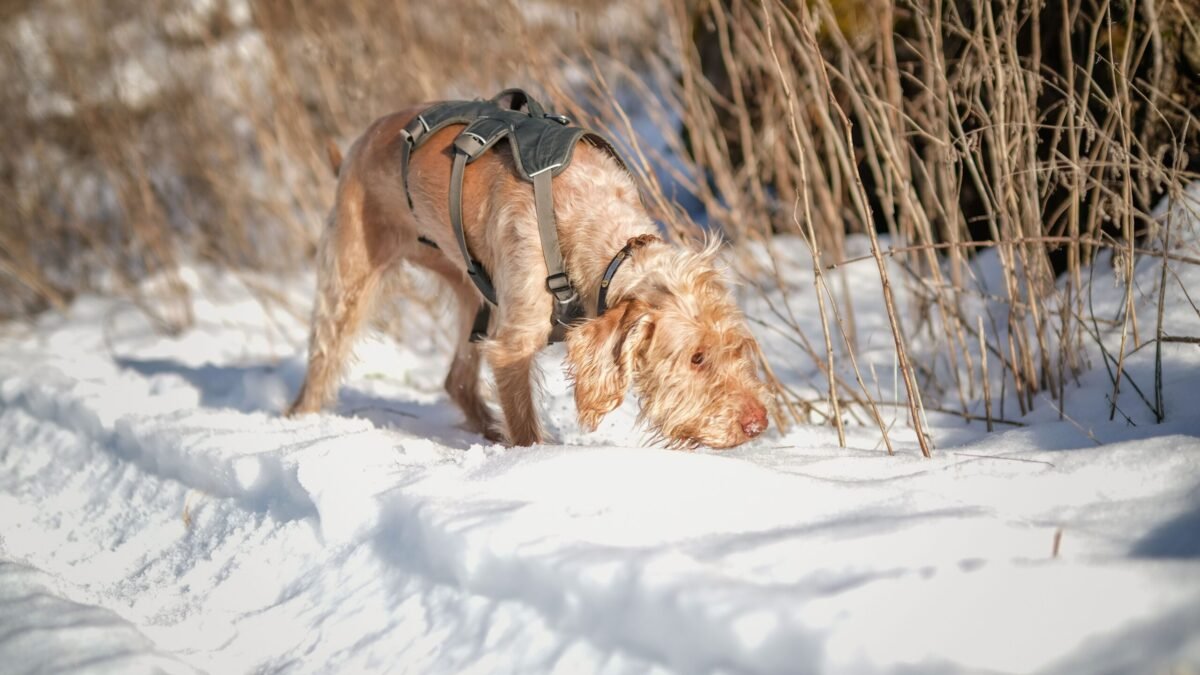
The most underused exercise tool in any apartment is the dog’s nose, and there is growing research behind that claim. Alexandra Horowitz, who studies canine cognition at Barnard College and wrote Inside of a Dog, has described how thoroughly smell organizes a dog’s experience of the world, and a 2019 paper by Clara Duranton and Horowitz, “Let me sniff!”, looked at how nosework activities relate to dogs’ wellbeing and argued that giving dogs the chance to sniff is a welfare matter rather than a luxury. Put simply, a slow walk where the dog is allowed to stop and read every lamppost is doing real work for him, work that a fast, purposeful march with the lead held short simply is not.
This is the single biggest change I would suggest to most city owners of working breeds. Turn one walk a day into a sniff walk, where the dog chooses the pace and the direction within reason, and where your job is to stand there patiently while he reads the news.
Same flat, three very different dogs
The clearest way to see why a single number fails is to picture three working breeds sharing the same fifty square meters. A Border Collie, bred to read livestock and make split-second decisions for hours at a time, tends to fall apart without a mental job; the late border collie Chaser, trained by the psychologist John Pilley, learned the names of more than a thousand objects, which tells you what that kind of mind can do with a bit of structure and how much of it is going unused on an ordinary pavement walk. A Vizsla, the elegant Hungarian pointing breed bred to range widely and cover ground beside the hunter all day, needs genuine running room, so a weekly trip to a forest or a field on a long line matters more for him than any amount of indoor games. And a scent-driven dog like my Lagotto needs the nose to be fed above all: with unhurried, sniff-led time outdoors he comes home settled, and on bad-weather days a small truffle from the freezer hidden around the flat does the same job in miniature.
Three dogs, three answers, and none of them is about minutes. The useful question is which part of the original job your dog is missing, and how you can give him a small, honest version of it.
A realistic daily shape for a working breed in a flat
Rather than a number, think of the day in layers, and know that you do not need every layer every day, only a reasonable mix over the week.
A proper outing with real freedom to sniff. One longer walk, ideally somewhere with grass, trees or at least a quieter route, where the dog is allowed to stop and investigate. For many working breeds this is the anchor of the day, and I would protect it before anything else. If you can reach a park, a river path or a forest edge a couple of times a week, even better, because the variety of scent is itself a form of enrichment.
Short, ordinary walks for the toilet and the routine. These count for less than you think, and that is fine. They are for keeping the day running, and a dog who is also getting a real outing will not mind them being brief.
Five to fifteen minutes of focused mental work. A hidden-treat search around the flat, a simple trick being learned, a food-dispensing toy, a bit of structured scent work with a few cardboard boxes. This is the layer apartment owners most often skip, and it is the one working breeds seem to repay most generously.
Real rest afterwards. A dog who has had a good session needs somewhere quiet to come down, and a working dog who never gets to settle can start to look like a dog with endless energy when what he actually has is a nervous system that is permanently switched on.
Signs the plan is not working
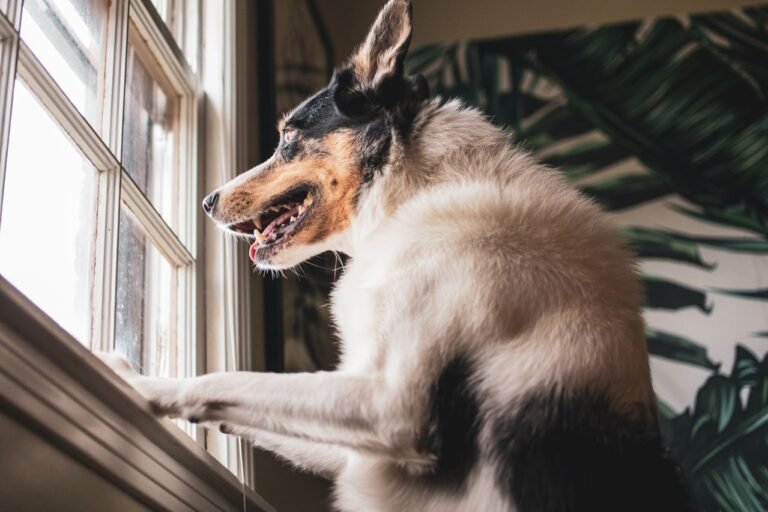
Dogs rarely say “I need more” in words, but they are quite consistent about showing it. A dog who is under-exercised physically tends to be restless in the evening, pacing, bringing you toys, nudging your hand. A dog whose mind is under-used often finds his own jobs, so look for sudden interest in the bin, shoes, the post, or a new habit of watching the window and barking at everything that moves. And a dog who is getting too much of the wrong kind, endless fast, exciting, high-arousal activity, can look strangely harder to settle after exercise than before it, which is a sign you may be building fitness and stress at the same time rather than satisfaction.
If you notice the last pattern, the answer is almost never “more.” It is usually a quieter, slower, nose-led version of the same time.
The honest part
Some working breeds, a hunting breed bred to cover ground for hours or a herding dog bred to run all day, do need real physical outlets, and a flat with only pavement walks will struggle to provide them. If you live in a city and share your home with one of these dogs, a weekly trip somewhere with space is not a luxury, it is part of the deal you accepted when you chose the breed. But a small flat is not the problem it is made out to be, because a dog who is physically tired and mentally satisfied is perfectly content to sleep through most of the hours he spends indoors, and most of those dogs will happily do so.
If you want a way to tell whether your dog is coping with city life more broadly, I put together a free guide, “5 Signs Your City Dog Is Overwhelmed,” which covers the early signals that something is off, including the ones that look like an exercise problem but are actually an overstimulation problem. You can grab it now.
Frequently Asked Questions
How many hours of exercise does a working breed need in an apartment?
There is no single honest number, because it depends on the breed’s original job and on the dog himself, but most working breeds do well with one longer outing a day that includes real sniffing time, plus shorter routine walks and a short session of mental work indoors.
Can a high-energy dog live happily in a small apartment?
Yes, as long as his physical and mental needs are met outside the flat. Square footage matters much less than what happens in the hours when the dog is awake and engaged.
Is mental stimulation really as tiring as a walk?
For many working breeds it is a surprisingly good substitute on bad-weather days, and a good complement on every other day. Ten minutes of scent work can leave a dog more settled than a much longer walk spent pulling on the lead.
Sources & further reading: breed differences in working ability and trainability, Stanley Coren; canine olfaction and cognition, Alexandra Horowitz, Inside of a Dog; sniffing and wellbeing, Duranton and Horowitz, “Let me sniff! Nosework induces positive judgment bias in pet dogs” (Applied Animal Behaviour Science, 2019)